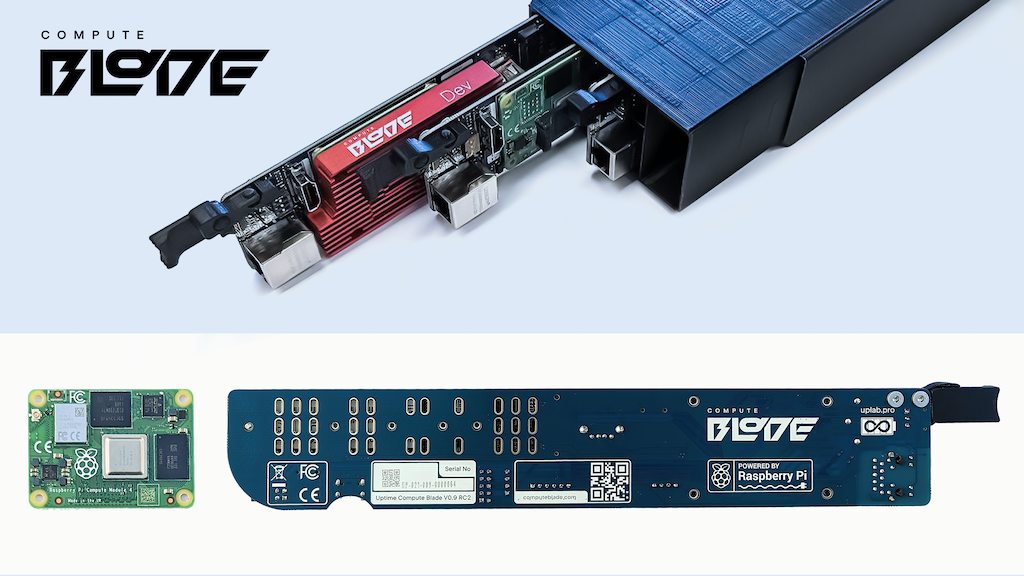
Feature-rich enterprise-level Raspberry Pi Compute Module 4 carrier board by Uptime Lab for large companies or home labs.
Latest Updates from Our Project:
Update 53
7 months ago
– Sat, Mar 21, 2026 at 01:12:55 PM
Hello,
Things have improved significantly since the last update. Unfortunately, we haven't been able to find all the parts, but fortunately, we've found the most expensive (PoE modules) and unique ones. This is what the situation on the production floor looks like right now: “The only thing we're working on now is 4 mechanical parts: we can't find the 2,000 latches and nameplates you printed; we're doing final checks now. We also need over 5,000 M2x2.5 screws and M2 nylon washers; we're doing one more count for them, and if they aren't found, we'll order them as well.”
The other missing components (mainly passive components, such as resistors, capacitors, and buttons) were ordered last week and are expected by the end of March. Production can begin immediately after that. I can print the 2,000 latches myself, which is what I’m working on right now. I’ve already done this before and attached 6 bags of parts to the shipment. But they were “lost.” At the moment, no additional payments are required from me, and I hope it stays that way. But I’ll have to buy more filament for the printer. Compared to everything else, that’s “no big deal.” I’ll keep you updated promptly on Discord. I plan to post the next update here in early April or sooner, if production starts.
I’m also in the process of deploying an Orchestrator test cluster on 20 Compute Blades in JetBrains (Munich office). For now, I’m figuring out how to seamlessly integrate the TeamCity workflow into the OS reinstall and update process. In my next update, I’ll go into more detail and share some photos of the rack installation.
Thank you for your patience! Ivan
Update 52
7 months ago
– Sat, Feb 28, 2026 at 10:44:06 AM
Hello, I promised to provide updates more frequently. Production of the new batch has not yet begun, but we have made progress. I will keep this brief.
As I mentioned, parts worth approximately $20k were lost. However, when the manager began calculating how much we could produce based on these inputs, it turned out that critical components worth $100k+ were missing. And then it became clear to me that it wasn't a few parts that were “lost,” but a couple of pallets. So we dug up the documents showing that 7 pallets had been shipped (I previously wrote 5, which was a mistake). The production signed delivery docks for the delivery of 7 pallets. But the manager reported that they only received 4!
We encountered significant delays in responses, and I had to literally demand a reply (despite the fact that five people from the manufacturer were already involved in the correspondence). This Tuesday, I asked them for “official” reasons and received the following:
"This Tuesday, I asked them for “official” reasons and received the following: With 2025-06-30 shipment we had our internal altium and rivile codes marked on each reel and also they were invoiced in that way. With the current order the supplier of components is [Uptime] this mean we had to create new altium and rivile codes for each position – it is our internal policy to not mix client supplied components with our warehouse stock, because some positions could be consolidated while purchasing and producing products using same components .
The warehouse seeing old stickers from last year may got confused and missed some positions during the check with current material POs with new altium/rivile numbers, we also moved production to new site, this may also had some effect due to moving of warehouse location."
Note: NO apologies
I have been writing to them almost every day for the past two weeks. And the last message on Friday was: "Today is the deadline for our warehouse to finalize the numbers of each component we have, I will come back with the final decisions from our side how many units we can start assembling asap"
I promised an update to you by the end of the month. And I warned on Tuesday that I needed answers from production, but I didn't receive anything.
Well, luckily, I managed to contact the manufacturer's CEO on LinkedIn (I suspect you may be reading this right now, as I gave the full context. Hello!) He promised to conduct an internal investigation into the situation and seems like a very serious person, so let's keep our fingers crossed.
On that note, I'll say goodbye and keep you posted. I have faith that the situation will finally move forward and that the components have not been lost after all.
I will be at the Embedded World exhibition on March 10–12 in Nuremberg at the JetBrains booth. I look forward to seeing you there. Let's agree on an update on Kickstarter after the exhibition (around March 15).
Ivan
Update 51
8 months ago
– Wed, Feb 11, 2026 at 03:20:09 PM
Hello,
There are two pieces of news, one bad and one good
1. Production has not yet begun.
For a long time, I was convinced that the problem lay in how I structured my processes and that I was not ‘professional’ enough to work with a large factory. But you know what? That's not the case. Looks like there are simply manufacturers or managers who prioritise and put startups and small orders at the bottom of their lists. And they literally drag out every single step. The experience of the last six weeks is a stark confirmation of this. Why were there no updates? To be honest, I had nothing to say, and I was very worried about it, I didn't even open Kickstarter. Sorry about that, I promised an update, but I messed up because of some very unpleasant and super unexpected news. I wrote briefly on Discord, but I keep forgetting that not all Kickstarter participants are there. The next here update will be short, but it will be before the end of the month, I'll try.
What happened: There are many updates, so I will briefly remind you that in the summer of 2025, there was a ‘Silicon Valley’ (TV series) spin-off with my company. It split up, I took all the IP and components related to Compute Blade, as well as Kickstarter, and founded a new company where I was the only one. I also got a new job. I began to support my company with my own funds and found a partner, a large distributor, pishop.us. In July 2025, the factory sent me five pallets of parts (worth about $200k) for the production of Compute Blade and closed the old contract. They also sent me a list of all the components. By the end of the year, everything was ready to continue production in partnership with pishop.us. Based on the list of parts we had, we bought the missing ones and, after lengthy correspondence, sent all the parts to production in early January.
Delivery took about 5 days, and counting the parts took almost 10. And what did we find out? There were fewer parts on the pallets than on the original list! Yes, we didn't count them, there are several tens of thousands of parts, and there is no reason to distrust the manufacturer. They are a large manufacturer and know how to count, right? In short, they were surprised, but from their point of view, of course, I was to blame. Then we had another two and a half weeks of correspondence on this issue. Basically, my questions were answered with ‘we are looking into it and will get back to you asap’, ‘we will recount and get back to you asap’, etc. (I really wanted to share screenshots of this wonderful correspondence, but I was told that it is absolutely unacceptable to do so and that it could end badly from a legal standpoint.) Right now, I am waiting for answers to two questions: 1. How much can we produce under the current conditions? 2. How much will it cost to purchase the missing parts? (according to my estimates, it will be between $9,000 and $23,000, as prices are very unstable at the moment)
2. Development of the Orchestrator and change of concept
A small demo is available on Discord. The project has already been improved and better adapted to specific tasks, so I will soon record a more complete demonstration in a production environment.
A long time ago, I talked about the orchestrator and showed some beautiful pictures. We had a backend that worked with PXE and had an agent on the devices. But it didn't work stably. PXE requires specific DHCP settings, which greatly lowers the entry threshold. Having an additional DHCP just for these settings works very poorly. As a result, I revised the concept and found what I think is the ideal option: HTTP Boot. This is a truly underrated feature of Raspberry Pi, along with the ability to customise EEPROM records.
Without going into technical details at this stage, here's what we got: 1. Network installation on empty devices (you will need to start them once from a USB flash drive or SD card, after which you can remove it) 2. The ability to completely reset the Raspberry Pi/Compute Blade without having to reconnect or reconfigure the device in the admin panel 3. Full recovery in case of SD card/NVMe failure 4. Workflow for mass configuration of devices using a template. Disk cleanup, OS installation, adding an orchestrator agent to the OS, and installing SSH keys or certificates. 5. Ability to edit configurations and even the boot order on devices from the admin panel.
In the coming weeks, we will set up a server at the JetBrains company (where more than 80 Compute Blades are currently deployed). And we will test it in real-world conditions. I will record a demo and be sure to share it. There is no clear business model for this product yet. But I am leaning towards a cloud Orchestrator with a package of free installations (4-5 devices). As well as team plans and enterprise plans, with the possibility of local deployment. The agent will definitely be open-source. As for the server side, we need to assess the feasibility, demand, and your feedback in general.
Just a couple of screenshots of the current version (they are already real, not just a piece of Figma):
___
With sincere appreciation Ivan
Update #50
10 months ago
– Tue, Dec 23, 2025 at 12:11:13 PM
Hello, this anniversary update, right before Christmas, was supposed to be something awesome and would have put an end to the project (in a good way).
But as you may have guessed, it won't be today.
The current situation hasn't changed much since the last update. Yes, I paid for the production of an additional batch, as planned. Yes, we've been sending out Kickstarter rewards for the past month and a half (you could see this on Discord), and we've actually emptied our warehouses in the hope of receiving a batch from production. Yes, we found a way to ship from Europe to other countries, and this will allow us to solve the problem of orders not covered by distributors in Europe and the US/CA.
But despite all the preliminary agreements, production did not manage to complete the batch on time. I don't want to make any accusations or excuses here before the holidays.
I messed up again. I didn't push them enough, I didn't call every day, I didn't go there and wait outside their office for an answer and progress.
I'm sorry.
I understand that my apology doesn't make it any easier for you. At the beginning of the year, when production finally starts, I will publish the key points from my correspondence with the manufacturer for everyone who needs proof.
The batch will definitely be completed and shipped as soon as it is ready.
And finally, I just want to wish you a Merry Christmas and a Happy New Year, smiles, time with your family, and rest. A healthy back, when needed, and healthy sleep, which is relevant to everyone.
Thank you for following the project, hating it, watching it like a Netflix series, or already receiving your device and being shocked that the project is not yet closed.
And may the Force be with you.
Ivan
Update #49
11 months ago
– Wed, Nov 05, 2025 at 08:54:41 AM
Hi!
The update will not be very big, as we have not progressed as far as we would have liked over the past two weeks. But I can assure you that work has been ongoing.
Except for that part of this time, our manager at Pi3G was on vacation, and the situation there was on hold for a while.
Just over 30 orders were shipped. Pishop handled complex orders in the US, where it was necessary to correspond with customers personally. This was all due to confusion with SKUs, a large number of accessories, and upgrades. I talked about this before. However, just in case, never do a Kickstarter with multiple options (too many), and definitely don't offer to change those options when choosing delivery terms.
*moment of self-reflection* It was probably done to squeeze the maximum revenue out of the project's success. We were able to raise an additional €225,343.21 through BackerKit on this. Additionally, we spent €32,825.95 on advertising and €1,700.00 on mailing, which ultimately did not bring any benefit. The headache it caused was definitely not worth it.
By the way, if you are interested in a retro analysis, let me know in the comments. I will tell you everything in detail with figures and a timeline in one of the future updates.
What else has been done?
Negotiations with production in the EU have progressed enough that we have already drawn up plans. We expect to have new Blades, Fan Units, and finally a heatsink for CM5 (backward compatible with CM4) in December.
As for my main job (you remember that I now work at JetBrains and don't take any more money out of the project), I was in China and happened to visit the NexPCB factories. They are the ones who made the RC2 Blades. And, coincidentally, the PiKVM. I also ate pigeon, but that's another story.
They have a showroom with projects they have worked on, and Compute Blade occupies a place of honor there.
And here are the PiKVM iterations
So, probably after the current batch, we will transfer production to them. They have grown significantly since RC2, and, more importantly, they can produce small batches quickly. This will allow us to respond much more flexibly to demand and develop new things.
Orders in the UK seem to be going smoothly, with about a quarter of all orders now shipped. We will continue in the same vein. Due to complications with commercial invoices for UPS, this is labor-intensive and takes more time.
And just some interesting numbers from current production. Initially, it was supposed to be 60k + heatsinks. But now it's like this, without heatsinks (they are separate). This is the cost of assembly only, excluding the price of the PCB and components, as well as their delivery:
It's not like selling software with its marginality :)
______
I wish you success with your personal projects! Ivan